<?xml version="1.0" encoding="utf-8"?><feed xmlns="http://www.w3.org/2005/Atom" ><generator uri="https://jekyllrb.com/" version="3.10.0">Jekyll</generator><link href="/feed.xml" rel="self" type="application/atom+xml" /><link href="/" rel="alternate" type="text/html" /><updated>2026-10-02T22:22:54+00:00</updated><id>/feed.xml</id><title type="html">Penduick</title><subtitle></subtitle><entry><title type="html">Robotics x Web3</title><link href="/robotics-web3/" rel="alternate" type="text/html" title="Robotics x Web3" /><published>2026-09-28T08:00:00+00:00</published><updated>2026-09-28T08:00:00+00:00</updated><id>/robotics-web3</id><content type="html" xml:base="/robotics-web3/"><![CDATA[<p>Robots entering our everyday lives and industries is the next logical step of the disruption we are living today, mainly through specialized industrial-grade robots rather than the humanoids we see everywhere. Web3 can bring valuable features to this future (robot identity, access to track records, ownership, coordination), allowing us to embrace this change in a better way than a future owned by a few centralized companies. Here is how I interpret the market and where I plan to focus to get exposure to robotics through Web3.</p>

<h2 id="why-im-looking-at-robotics">Why I’m looking at robotics</h2>

<p>The world, and more precisely the digital world, has been deeply transformed over the last few years by advances in LLMs. Although the transformation is lagging behind the frontier, as it takes time for people and industries to absorb new technologies, we can already see major changes happening in many sectors: software development, finance, design etc. The impact will be enormous, but limited to the digital world.</p>

<p>The next natural step is to automate even further, by automating our physical world  with use cases we couldn’t have imagined a few years ago. And you know what’s wonderful? The first innovation serves the second one, allowing us to go further, faster and better. Innovation is accelerating. Large amounts of capital are already flowing into robotics projects and their mechanical needs, and more and more engineers are diving into the subject.</p>

<p>This next step is natural and logical, yes. But it is also very much needed. Labor shortages, aging populations, the danger and health impact of some processes, or just simply the will to consume locally produced goods all make robotics the right answer. Robots will solve problems software never could. That’s why we’re shifting from an era of bits to an era of atoms. And its potential impact is even larger than the bits era (even though the digital world was always a way to improve the physical one): the physical world representing 75% of the world’s economic activity.<sup><a href="#src-1">1</a></sup></p>

<p>Such impacts also raise a fair number of challenges: how can we identify robots? Check what they produced? Access them freely to perform tasks, regardless of their OS or brand? How can my AI agents delegate subtasks and pay for them? How will companies finance such capex?
I think Web3 answers some of these challenges well, thanks to its native features (transparency, decentralization) and to building blocks now mature: stablecoin rails, onchain identity, fast and low-cost transactions etc.</p>

<h2 id="sector-baseline">Sector baseline</h2>

<p>We recently saw US- and China-based companies raise billions of dollars from VCs and public capital markets. There is definitely an insatiable appetite here. But this appetite seems mainly focused on humanoid robots. Humanoids are good for marketing as they speak to everyone especially if you’re a sci-fi nerd. They also have the theoretical advantage of fitting into existing processes and infrastructures to automate human tasks. But in reality, the human form is suboptimal for a lot of tasks. And, while domestic robots are possible and an interesting market, the real revenue generators are industrial robots. The robotics revolution will be driven by aging and decreasing demography. But in households, adoption will be slower due to cost, safety and regulation.</p>

<div class="metrics-table-wrap metrics-table-wrap--map">
  <table class="metrics-table">
    <thead>
      <tr>
        <th>Sector</th>
        <th>Economic size</th>
        <th>What the robot replaces</th>
        <th>Capturable value</th>
      </tr>
    </thead>
    <tbody>
      <tr>
        <th scope="row">Manufacturing</th>
        <td>$16.83 trillion in value added in 2024, or 15% of global GDP<sup><a href="#src-2">2</a></sup></td>
        <td>Paid labor, on repetitive and structured tasks</td>
        <td>High: measurable and billable productivity gains</td>
      </tr>
      <tr>
        <th scope="row">Construction</th>
        <td>About $10 trillion in annual spending; value added could rise by $1.6 trillion a year<sup><a href="#src-3">3</a></sup></td>
        <td>Paid labor, in a sector with stagnant productivity</td>
        <td>Very high: a large productivity gap to close</td>
      </tr>
      <tr>
        <th scope="row">Households</th>
        <td>No direct market value: domestic work is mostly unpaid</td>
        <td>Often unpaid domestic work (housework, assistance, companionship)</td>
        <td>Lower: a consumer product, low prices, margins under pressure</td>
      </tr>
    </tbody>
  </table>
</div>

<p>That being said, every robot relies on its mechanical layer: actuators, sensors, energy etc. There have been many advances in these fields, enabling better control and feedback while driving prices down dramatically. Foundation models are also evolving fast, as the engine powering robots’ movements and their understanding of the outside world. I’m confident both will improve drastically.</p>

<p>We are already seeing capability demonstrations in real-world conditions, but we haven’t yet reached the stage where they can handle everything autonomously. A huge bottleneck to reach this is training data. For foundation models to understand the world, deduce possible actions and anticipate their direct and indirect consequences, a lot of data is needed. Unlike LLMs, which have access to the whole internet, the physical world has no such data source (videos exist and are usable, but incomplete). Moreover, the data is way different from one robot to another, as mechanical parts differ and age. Some layers of physical interaction remain generalizable though.</p>

<p>In today’s market, industrial automation and robotics are dominated by a few well-established actors: ABB, Fanuc, Yaskawa etc. Each new installation requires engineering teams to design, commission and test the system. Robots from different brands can communicate through an open standard protocol (OPC UA) but development remains siloed, as each brand has its own programming language.</p>

<p>On the crypto side, projects such as peaq, CodecFlow and Fabric (ROBO) are already working on the subject, some of them for nearly a decade. Recent advances in hardware and foundation models, along with the many new initiatives emerging (AMI Labs, etc.), show growing interest in the field and increase the likelihood of major challenges being solved in the coming years. Until now, there were very few use cases, and token prices reflected it. As things start to change, this could be a great time to position ourselves to capture as much upside as possible.</p>

<h2 id="why-do-we-need-crypto-what-does-it-bring">Why do we need crypto? What does it bring?</h2>

<p>Let’s be honest: Web3 doesn’t push the robotic market further in use cases or innovation. Nothing is technologically unlocked by it. What it brings is a neutral infrastructure around robots, enabled by three features of blockchain technology: verifiable records, autonomous payments and programmable ownership.</p>

<p><strong>Verifiable records: a database nobody controls</strong></p>

<p>The robotic market involves many parties that don’t necessarily share the same interests, and therefore don’t necessarily trust each other: a manufacturer, an integrator, a maintainer, an operator, a client and also investors, insurers etc. Today, a robot’s setup, production and quality data sit in proprietary systems, often accessible to the maintainer and operator but rarely accessible in detail, even to the robot’s owner. By storing onchain the hash of the robot’s data (work, parameters, quality, maintenance, uptime etc.) signed directly by the machine, every party has openly access to the same level of information at any time without needing to trust each other. This enables use cases such as:</p>

<ul>
  <li><strong>Responsibility:</strong> establishing which party is responsible for an outcome, based on a record no single party can rewrite.</li>
  <li><strong>Robot life history:</strong> work done, uptime, parts replaced, profitability. This is valuable when reselling a machine, valuing a tokenized one or choosing a robot to perform a task.</li>
  <li><strong>Quality proof:</strong> each action’s parameters (torque, dimensions, cycle times) can be checked for conformity. This is especially useful in highly regulated industries.</li>
  <li><strong>Measurable ROI:</strong> with proof of work produced, a robot’s financial contribution can be measured precisely. This opens up financing through tokenization, and new business models where robot providers are paid for work produced rather than for a one-off sale.</li>
</ul>

<p><strong>Autonomous payments: wallets for agents and machines</strong></p>

<p>Like AI agents, a robot cannot open a bank account (and even if it could in the future, a bank account is inappropriate for autonomous micropayments). That’s what stablecoin rails solve by giving them a wallet, enabling:</p>

<ul>
  <li><strong>Machine-to-machine payments:</strong> an AI agent delegates a physical subtask to a robot it discovered and selected onchain, and pays it autonomously to perform the task. For example, one company’s agent can delegate the production of a part to a supplier, autonomously, without human intervention for engineering, quotation and production. Supplier selection can be done without centralized marketplace, based on onchain identity and verified track-record.</li>
  <li><strong>Micropayments:</strong> a user can buy a service (per task or per minute) or a product and the robot receives and handles the payment directly, automating invoicing and settlement.</li>
  <li><strong>Programmable revenue sharing:</strong> owners of a tokenized robot can automatically receive their share of the revenue.</li>
</ul>

<p><strong>Programmable ownership: machines as investable assets</strong></p>

<p>With verifiable records, machines can be tokenized and owned by one or several people. This unlocks use cases such as:</p>

<ul>
  <li><strong>Financing:</strong> fractional ownership allows small companies, for example, to finance their machines by selling shares of them, managing their risk and accessing new capital (small investors, partial financing etc.).</li>
  <li><strong>Easy transfer:</strong> buying or selling such a robot becomes as easy as transferring a token, from anywhere in the world and at any time.</li>
</ul>

<p>Those use cases apply to domestic robots too.</p>

<h2 id="market-mapping">Market mapping</h2>

<p>Here is how I slice the market into core layers, each providing features robots need, from physical foundations at the bottom to economic use cases at the top.</p>

<div class="market-map">
  <div class="market-plugs">
    <section class="market-plug">
      <header class="market-layer-head">
        <p class="market-layer-title">Use cases (Robots-as-a-Service)</p>
      </header>
      <div class="market-field">
        <p class="market-field-label">Web2 actors</p>
        <p>Formic, Locus Robotics, Brain Corp</p>
      </div>
      <div class="market-field">
        <p class="market-field-label">Web3 projects</p>
        <p>Pilots only</p>
      </div>
      <div class="market-field">
        <p class="market-field-label">What Web3 brings</p>
        <p>RaaS model already exists; Web3 adds proof of work, autonomous payments and split ownership</p>
      </div>
    </section>
    <section class="market-plug">
      <header class="market-layer-head">
        <p class="market-layer-title">Ownership and financing</p>
      </header>
      <div class="market-field">
        <p class="market-field-label">Web2 actors</p>
        <p>Leasing, venture capital, debt</p>
      </div>
      <div class="market-field">
        <p class="market-field-label">Web3 projects</p>
        <p>peaq, XMAQUINA</p>
      </div>
      <div class="market-field">
        <p class="market-field-label">What Web3 brings</p>
        <p>Fractional ownership, automatic revenue distribution and access to capital 24/7 from anywhere in the world.</p>
      </div>
    </section>
    <section class="market-plug">
      <header class="market-layer-head">
        <p class="market-layer-title">Payments</p>
      </header>
      <div class="market-field">
        <p class="market-field-label">Web2 actors</p>
        <p>Stripe, Visa etc.</p>
      </div>
      <div class="market-field">
        <p class="market-field-label">Web3 projects</p>
        <p>x402, Circle, Tether</p>
      </div>
      <div class="market-field">
        <p class="market-field-label">What Web3 brings</p>
        <p>Payment rails designed for and usable by machines.</p>
      </div>
    </section>
    <section class="market-plug">
      <header class="market-layer-head">
        <p class="market-layer-title">Identity and verifiable records</p>
      </header>
      <div class="market-field">
        <p class="market-field-label">Web2 actors</p>
        <p>Proprietary platforms of manufacturers, digital twins</p>
      </div>
      <div class="market-field">
        <p class="market-field-label">Web3 projects</p>
        <p>peaq, Fabric Protocol</p>
      </div>
      <div class="market-field">
        <p class="market-field-label">What Web3 brings</p>
        <p>Openly accessible onchain robot identity and tamper-proof work history.</p>
      </div>
    </section>
    <section class="market-plug">
      <header class="market-layer-head">
        <p class="market-layer-title">OS and foundation models</p>
      </header>
      <div class="market-field">
        <p class="market-field-label">Web2 actors</p>
        <p>Nvidia (GR00T, Isaac, Cosmos), Physical Intelligence (π models), Google DeepMind (Gemini Robotics), Skild AI, AMI Labs</p>
      </div>
      <div class="market-field">
        <p class="market-field-label">Web3 projects</p>
        <p>OpenMind, CodecFlow, Bittensor Subnet 80</p>
      </div>
      <div class="market-field">
        <p class="market-field-label">What Web3 brings</p>
        <p>Integrated identity and payment features, incentivized improvement of open models</p>
      </div>
    </section>
    <section class="market-plug">
      <header class="market-layer-head">
        <p class="market-layer-title">Data</p>
      </header>
      <div class="market-field">
        <p class="market-field-label">Web2 actors</p>
        <p>In-house collection (Tesla, Figure etc.), teleoperation farms or simulated data (Nvidia Isaac/Cosmos, Hub.xyz)</p>
      </div>
      <div class="market-field">
        <p class="market-field-label">Web3 projects</p>
        <p>PrismaX, BitRobot, Axis Robotics, NRN Agents</p>
      </div>
      <div class="market-field">
        <p class="market-field-label">What Web3 brings</p>
        <p>Tokens can bootstrap a decentralized infrastructure producing high-quality data when collection requires capex-heavy hardware. When data is simply paid human time, stablecoin payments are enough.</p>
      </div>
    </section>
    <section class="market-plug">
      <header class="market-layer-head">
        <p class="market-layer-title">Hardware</p>
      </header>
      <div class="market-field">
        <p class="market-field-label">Web2 actors</p>
        <p>Components: Harmonic Drive, Nabtesco, Sony, Hesai</p>
        <p>Robots: ABB, Fanuc, Yaskawa, KUKA, Unitree, Figure, Boston Dynamics, Tesla Optimus</p>
      </div>
      <div class="market-field">
        <p class="market-field-label">Web3 projects</p>
        <p>—</p>
      </div>
      <div class="market-field">
        <p class="market-field-label">What Web3 brings</p>
        <p>—</p>
      </div>
    </section>
  </div>
</div>

<p>As shown above, Web3 adds value on specific layers only: data, identity, verifiable records, payments and ownership. That’s where I will focus my investments.
This mapping is subject to changes as the market evolves.</p>

<h2 id="risks-and-invalidation-events">Risks and invalidation events</h2>

<p><strong>Risks</strong></p>

<ul>
  <li>Of course, everything stated above depends on how far robots penetrate the market. The less siloed they are in privately owned factories, the more accessible, discoverable and hireable they become, the stronger the need for those building blocks will be.</li>
  <li>Moreover, as with every Web3 project, regulation is still a gray area, especially for owning underlying assets through tokens. A change in how tokens are classified could reduce liquidity and R/R if investments.</li>
  <li>Regarding onchain verifiability: what is stored on the blockchain isn’t the data itself but its hash. The hash lets you check the data’s integrity, once you have the data. To do so, you have to obtain it from the right parties, which can be painful since it is stored in proprietary systems and is often sensitive. This currently limits the value of onchain verifiability and it is a challenge that must be solved for the feature to become indispensable. It opens the door for privacy-preserving onchain storage solutions.</li>
  <li>A Web2 company with good GTM strategy and UX could provide the features described above in a centralized way. If users are happy with that, it invalidates the whole thesis.</li>
</ul>

<p><strong>Invalidation events</strong></p>

<ul>
  <li>If robot deployments stay limited to pilots while funding to the sector dries up, I will de-risk my investments in the sector.</li>
  <li>If revenue-sharing robot tokens are classified as securities, I will limit my ownership-layer exposure to regulated platforms.</li>
  <li>If major robot manufacturers launch their own identity and payment layers, I will exit the Web3 projects addressing those problems.</li>
</ul>

<h2 id="conclusion">Conclusion</h2>

<p>Web3 doesn’t make robots better. What it can bring is a neutral infrastructure around them, built on three features: verifiable records, autonomous payments and programmable ownership.</p>

<p>Mapping the market shows that this value is concentrated on a few layers: training data (requiring capex-heavy collection infrastructure), robot identity and work history, machine payments, ownership and financing. That’s where I’ll focus. Hardware, foundation models and most decentralized data collection projects are out of scope for my Web3 investments: I see no decisive edge for crypto there. My horizon is long-term: the need for this infrastructure will grow with robot deployment, not with crypto cycles.</p>

<p>Next step: deep dives on the projects behind each layer.</p>

<p>My brain is open, especially if you disagree with me.</p>

<p>NFA.</p>

<hr />

<h4 id="sources">Sources</h4>

<ol>
  <li><a id="src-1"></a>Eclipse, <a href="https://ecoreport.eclipse.vc/"><em>Eclipse Carbon Optimization Report</em></a> (2023) — physical industries account for 75% of global economic activity.</li>
  <li><a id="src-2"></a>World Bank, compiled by Cargoson, <a href="https://www.cargoson.com/en/blog/mekkora-a-feldolgozoipar"><em>How Big is the Manufacturing Industry?</em></a> — $16.83 trillion of manufacturing value added in 2024, 15% of global GDP.</li>
  <li><a id="src-3"></a>McKinsey Global Institute, <a href="https://www.mckinsey.com/~/media/mckinsey/business%20functions/operations/our%20insights/reinventing%20construction%20through%20a%20productivity%20revolution/mgi-reinventing-construction-executive-summary.pdf"><em>Reinventing Construction</em></a> (executive summary, 2017) — about $10 trillion in annual construction spending, and $1.6 trillion of additional value added.</li>
</ol>

<p><em>Carlos</em></p>]]></content><author><name></name></author><category term="VC" /><category term="Web3" /><category term="robotics" /><summary type="html"><![CDATA[Robots entering our everyday lives and industries is the next logical step of the disruption we are living today, mainly through specialized industrial-grade robots rather than the humanoids we see everywhere. Web3 can bring valuable features to this future (robot identity, access to track records, ownership, coordination), allowing us to embrace this change in a better way than a future owned by a few centralized companies. Here is how I interpret the market and where I plan to focus to get exposure to robotics through Web3.]]></summary></entry><entry><title type="html">Wingbits: DePIN aviation data</title><link href="/wingbits/" rel="alternate" type="text/html" title="Wingbits: DePIN aviation data" /><published>2026-08-09T12:00:00+00:00</published><updated>2026-08-09T12:00:00+00:00</updated><id>/wingbits</id><content type="html" xml:base="/wingbits/"><![CDATA[<p>I’m passing on Wingbits.
The team is very strong, but they need to onboard +$3.5M to finance their network while having huge investors and team unlocks very soon. TAM seems to constrained to me for a VC investment. Would love to have the founders vision.
Here is my detailed analysis.</p>

<figure class="post-cover">
<img src="../assets/wingbits/wingbits_logo.png" alt="Wingbits logo" />
</figure>

<h2 id="project">Project</h2>

<p>Wingbits is a DePIN project creating a decentralized physical infrastructure of flight tracking devices. People participating in the project install an ADS-B antenna at their homes, capture aircraft ADS-B signals (which contain useful data such as speed, position, etc.) and send them to Wingbits. The data is then available through the Wingbits API or an LLM for analysis. Customers consume this valuable data to optimize fleet routing, airport terminal management, asset-use tracking, etc.</p>

<p>Wingbits is a concrete example of how blockchain technology and token incentives can be used to improve and disrupt a Web2 business by making the network more reliable and dense.
Today’s aviation industry relies on an ADS-B antenna network provided for free by people installing antennas at home. The incentives for people are bad (unless you really want to get free API access) and companies’ interests aren’t aligned with those of data providers, who are neither interested in the company’s profits nor incentivized to share quality data. Wingbits creates an alternative approach, incentivizing station owners to provide high-quality data, as they will receive more rewards for this, rewards whose value is designed to increase over time. Wingbits claims to currently have a 6K+ station network providing data in more than 120 countries.</p>

<p>That’s the vision. Let’s now analyze whether the mechanism design is healthy enough to do so.</p>

<h2 id="market">Market</h2>

<p>Modern aircraft are required to send an ADS-B (Automatic Dependent Surveillance Broadcast) signal 2x per second. Such signals contain aircraft position, altitude, speed and ID. As it is an unencrypted and open signal, anyone can capture it through an antenna on the ground. Thanks to a network with global coverage, such data can be used in the following use cases:
<strong>Airlines:</strong> optimize aircraft routing in real time thanks to weather conditions and actual zone traffic, competitors’ flight analysis, environmental reports, safer flights (no black holes), etc.
<strong>Airports:</strong> gate optimization by predicting flight delays more precisely.
<strong>Banks:</strong> check if the financed aircraft are used as stipulated in the loan contract, adjust their risk exposure by verifying real aircraft usage.
<strong>Insurers:</strong> check usage-contract compliance and analysis of incidents.
<strong>Economists:</strong> use aircraft traffic in real time to measure the economy’s health.</p>

<p>Some companies already provide this data, thanks to volunteer station owners. They still manage to build very profitable businesses by doing so, showing us how much interest there is in consuming such data. Here is an overview of 3 of these companies’ KPIs:</p>

<div class="metrics-table-wrap">
<table class="metrics-table">
  <thead>
    <tr>
      <th>Metrics</th>
      <th>FlightRadar24</th>
      <th>FlightAware</th>
      <th>Aireon</th>
    </tr>
  </thead>
  <tbody>
    <tr>
      <th scope="row">Valuation</th>
      <td>$500M (2025)</td>
      <td>~$500M+</td>
      <td>$760M</td>
    </tr>
    <tr>
      <th scope="row">Revenue</th>
      <td>40M€ (50% profit)</td>
      <td>$49.5M</td>
      <td>$100M</td>
    </tr>
    <tr>
      <th scope="row">Business model</th>
      <td>Free public version financed by ads + paid data access (B2C + B2B)</td>
      <td>Free public version financed by ads + paid data access (B2C + B2B)</td>
      <td>EASA-certified data to critical customers</td>
    </tr>
    <tr>
      <th scope="row">Stations</th>
      <td>55k</td>
      <td>45k</td>
      <td>100% Earth coverage thanks to satellite network</td>
    </tr>
  </tbody>
</table>
</div>

<p>The market is split into 2 segments:</p>
<ul>
  <li>the highly critical systems with contractual liability (contractually locked).</li>
  <li>the commercial information, for non-critical use cases (listed before).</li>
</ul>

<p>The first one provides a 100% coverage network thanks to a satellite constellation receiving the ADS-B data from anywhere on Earth. Aireon has contracts and a network nearly impossible to compete with. However, the market for such data is already saturated (that’s why Aireon’s YoY growth is about 10%). Customers here are ANSPs (Air Navigation Service Providers), and there is only a limited number of them (1 per airspace). A lot of them are already customers.</p>

<p>The second one addresses a bigger market (~$300M/year*), growing with use cases (FR24: 18%, Aireon: 10%). This segment is also more competitive. Multiple actors have built a network nearly for free: providers can get a Raspberry Pi and an antenna to provide data and receive a free subscription to the API of the company they are selling to. They all rely on hobbyists and it works pretty well. The fact that a DePIN project has to pay in order to create such a network can be a clear disadvantage as competitors have an acquisition cost of ~$0. The current companies improve their quality and coverage thanks to satellite data when needed.</p>

<p>The only advantage I see for Wingbits is that they can improve ground coverage at a minor cost compared to satellite data, by convincing people who aren’t interested in free API access with remuneration. But competitors have the cash to pay new stations too if they want to. No moat. I found no customer willing to pay for cryptographically verified data. I’d be happy to be proven wrong.</p>

<p class="legend"><em>* bottom-up estimation</em></p>

<h2 id="pain-points">Pain points</h2>

<p>As with every DePIN project, the main key to success is unlocking the flywheel.</p>

<figure class="chart-embed chart-embed--flywheel">
  <div class="flywheel-scaler" data-fw-width="1080" data-fw-height="980">
    <iframe src="../assets/wingbits/flywheel.html" title="Wingbits network flywheel" loading="eager"></iframe>
  </div>
</figure>
<script src="../assets/wingbits/flywheel-embed.js" defer=""></script>

<p>Everything relies on the ability of the team to onboard new stations, creating data good enough to drive customer demand, generating revenue that burns tokens, increasing the attractiveness to install a station and so on.</p>

<p><strong>But how do you convince people to join your network?</strong></p>

<ol>
  <li>You convince new people outside of this niche market to contribute. At first, they can be crypto-native people, but the fewer the better.</li>
  <li>You convert competitors’ network station owners by having an attractive incentivization and selling them a better product vision. This is the easiest way as it doesn’t rely on market evangelization. They already are aviation data nerds. However, product and vision have to be very attractive to them as they will need to buy new hardware in order to contribute, their existing one being incompatible with Wingbits’ data authentication requirements.</li>
</ol>

<p>Both ways rely on communication and marketing to make the project known to many and convert them. And that is where, in my opinion, their weakness is. They have low engagement on X, with a few aircraft route display posts a week. I don’t think it’s the way you make people understand the market, why the project needs them, how they can contribute and why it is interesting for them to do it. But those steps are necessary to convince people (crypto or non-crypto natives) to contribute, particularly in low-coverage areas. Those areas are necessary to differentiate from competitors.</p>

<p><em>Outstanding questions:</em>
<em>Do they have a presence at aviation trade shows?</em> <em>What is their strategy to onboard data providers?</em></p>

<p>Another point: their token burn mechanism is discretionary and not programmatic, so it relies on trust. It’s a quick win to make it programmatic to improve trust in the project. <strong><em>Why not do it?</em></strong></p>

<h2 id="team">Team</h2>

<p>The team they managed to build is one of their biggest assets. A lot of them have multiple exits or built strong businesses and worked in high-growth companies.</p>

<figure class="team-photo">
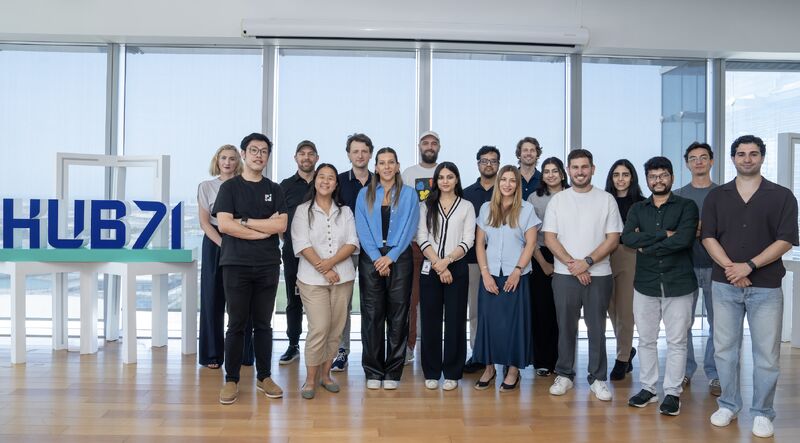
<img src="../assets/wingbits/wingbits_team.jpg" alt="Wingbits team" />
</figure>

<div class="team-roster">
  <div class="team-roster-card">
    <p class="team-roster-dept">CEO</p>
    <p class="team-roster-name"><a href="https://www.linkedin.com/in/robinwingardh/details/experience/">Robin Wingårdh</a> <span class="team-roster-role">Co-founder</span></p>
    <p class="team-roster-signal">Multi-time entrepreneur with strong business development skills. Sold one company. Business Development Manager at Klarna.</p>
  </div>
  <div class="team-roster-card">
    <p class="team-roster-dept">CTO</p>
    <p class="team-roster-name"><a href="https://www.linkedin.com/in/alexandrulungu/">Alex Lungu</a> <span class="team-roster-role">Co-founder</span></p>
    <p class="team-roster-signal">Technical management skills acquired throughout his career. Supported Klarna Engineering for 4+ years. Went from software engineer to an engineering management role.</p>
  </div>
  <div class="team-roster-card">
    <p class="team-roster-dept">Hardware</p>
    <p class="team-roster-name"><a href="https://www.linkedin.com/in/shawaj/details/experience/">Aaron Shaw</a> <span class="team-roster-role">Technical lead</span></p>
    <p class="team-roster-signal">Serial entrepreneur. Co-founded companies going from 0 to multi-million in revenue. Strong hardware experience.</p>
  </div>
  <div class="team-roster-card">
    <p class="team-roster-dept">Data science</p>
    <p class="team-roster-name"><a href="https://www.linkedin.com/in/silvano-garnerone/details/experience/">Silvano Garnerone</a> <span class="team-roster-role">Head of Data Science</span></p>
    <p class="team-roster-signal">Scaled Klarna data infrastructure by 10×. Went from Data Scientist to managing the whole Data Science team.</p>
  </div>
  <div class="team-roster-card">
    <p class="team-roster-dept">Growth</p>
    <p class="team-roster-name"><a href="https://www.linkedin.com/in/yanal-m-hammouda-2424204a/details/experience/">Yanal M. Hammouda</a> <span class="team-roster-role">Head of Expansion</span></p>
    <p class="team-roster-signal">Co-founded and sold 2 companies. Led tens of millions of $ worth of deals. Managed growth.</p>
  </div>
  <div class="team-roster-card">
    <p class="team-roster-dept">Sales</p>
    <p class="team-roster-name"><a href="https://www.linkedin.com/in/jeff-w-01130b1a4/">Jeff W.</a> <span class="team-roster-role">Head of Product and Commercial Strategy</span></p>
    <p class="team-roster-signal">Previously Director of Sales &amp; Partnerships at ADSBexchange.com. Growth strategy and network in the market for 3+ years.</p>
  </div>
</div>

<p>The whole team is about 20 people, from software engineers to data scientists, hardware engineers to operations and sales. A bunch of them met at Klarna, a multi-billion dollar fintech that IPO’d in 2025, with strong growth (71× on revenue between 2012 and 2025).</p>

<p>I have no doubt about their capacity to execute.</p>

<h2 id="token">Token</h2>

<p>At the heart of the flywheel is the incentive: the $WINGS token.</p>

<div class="synthesis-specs">
<ul>
  <li><span>Supply: </span>10B tokens</li>
  <li><span>Chain: </span>Solana</li>
  <li class="synthesis-spec-wide"><span>Contract:</span> <a href="https://solscan.io/token/WingsAYbfs4qnEgcw8jpSvetqp8XHM3GkKvow54WLcd"><code>WingsAYbfs4qnEgcw8jpSvetqp8XHM3GkKvow54WLcd</code></a></li>
</ul>
</div>

<p>Here is the token allocation diagram:</p>

<figure class="chart-embed chart-embed--allocation">
<iframe src="../assets/wingbits/wings-token-allocation.html" title="WINGS token allocation" loading="eager"></iframe>
</figure>

<p>I think the community share could have been bigger but this isn’t alarming to me.</p>

<p>However, Wingbits raised 2 rounds: $3.5M in 2024 and $5.6M in 2025 from <em>Borderless Capital, Tribe Capital, Bullish Capital.</em> Part of the fundraising was in token issuance: 24.5% of the total supply. Here are the terms of the investors’ deal to unlock their tokens:</p>

<div class="metrics-table-wrap">
<table class="metrics-table">
  <thead>
    <tr>
      <th>Category</th>
      <th>Cliff</th>
      <th>Vesting</th>
    </tr>
  </thead>
  <tbody>
    <tr>
      <th scope="row">Investors</th>
      <td>6 months</td>
      <td>12 months</td>
    </tr>
    <tr>
      <th scope="row">Team</th>
      <td>12 months</td>
      <td>24 months</td>
    </tr>
  </tbody>
</table>
</div>

<p>I find the investors’ terms pretty bad for the project. The investors aren’t committed to the long-term success as they will be able to fully exit their position ~2 years after investing. Pretty short for venture capital. From my point of view, VCs must be willing to be in for a decade if needed.<br />
Team vesting is acceptable without being very generous on long-term alignment.</p>

<h2 id="tokenomics">Tokenomics</h2>

<p><strong>In DePIN projects, the token is how you incentivize providers to grow the network, and so to make the product better over time by activating the flywheel. To judge whether Wingbits’ design is healthy, I first ask what price $WINGS has to hold for the network to keep growing, then what that price implies for valuation, revenue, and sell pressure.</strong></p>

<h3 id="1---what-token-price-sustains-network-growth">1 - What token price sustains network growth?</h3>

<p>Rewards are split with a PageRank-style algorithm (location, coverage, uptime, plus bonuses). The formula is private, so I work backwards from on-chain claims: what does the median station actually earn, and what ROI does that imply? I treat a ~24- to 30-month payback as the acceptable bar.</p>

<p><em>Everything below is based on tokens that were transferred, so claimed ones only. As unclaimed rewards are invisible, the following figures can be understated.</em></p>

<figure class="chart-embed">
<iframe src="../assets/wingbits/wallet_growth.html" title="Growth of unique reward wallets" loading="eager"></iframe>
</figure>

<p>Unique claiming wallets are a proxy for network growth, as long as stations claim regularly. Growth looks flat. About 3k wallets have claimed, versus the 6k stations the project announces. There may be a large share of stations not claiming their rewards yet.</p>

<figure class="chart-embed">
<iframe src="../assets/wingbits/wallet_active_days.html" title="Distribution of active reward days per wallet" loading="eager"></iframe>
</figure>

<p>Most wallets claimed only a few times. Among stations that claimed at least twice, here is the distribution of mean daily rewards:</p>

<figure class="chart-embed">
<iframe src="../assets/wingbits/wallet_daily_reward_distribution.html" title="Distribution of median daily reward per wallet" loading="eager"></iframe>
</figure>

<p>The median is the right reference: if mid-tier stations are not paid enough, coverage, uptime and redundancy suffer.</p>

<div class="tokenomics-calc">
  <p class="tokenomics-calc-label">Median station at $0.005</p>
  <table class="tokenomics-calc-table">
    <colgroup>
      <col class="tokenomics-calc-col-label" />
      <col class="tokenomics-calc-col-tokens" />
      <col class="tokenomics-calc-col-usd" />
    </colgroup>
    <thead>
      <tr>
        <th></th>
        <th>Tokens</th>
        <th>USD</th>
      </tr>
    </thead>
    <tbody>
      <tr>
        <th scope="row">Daily</th>
        <td>194.8 $WINGS</td>
        <td>$0.97</td>
      </tr>
      <tr>
        <th scope="row">Monthly</th>
        <td>5,844 $WINGS</td>
        <td>$29.1</td>
      </tr>
      <tr>
        <th scope="row">OPEX</th>
        <td>$40 / year</td>
        <td>$3.50 / mo</td>
      </tr>
      <tr>
        <th scope="row">Profit</th>
        <td>N/A</td>
        <td>$25.6 / mo</td>
      </tr>
      <tr>
        <th scope="row">Hardware</th>
        <td>N/A</td>
        <td>$800</td>
      </tr>
      <tr>
        <th scope="row">Payback</th>
        <td>N/A</td>
        <td>≈ 30 months</td>
      </tr>
    </tbody>
  </table>
</div>

<p><em>Note: Some stations earn a lot more (early-bird or low-altitude bonuses). Wingbits also gifts hardware in high-interest locations.</em></p>

<p>30 months is on the high side, but still acceptable. Today’s price is therefore the <strong>floor</strong> to onboard new stations and expand into low-coverage areas.</p>

<p>Here are some cases of token prices needed for the project to stay viable, depending on the ROI bar we set:</p>

<div class="metrics-table-wrap">
<table class="metrics-table">
  <thead>
    <tr>
      <th>Target</th>
      <th>Token price</th>
      <th>vs now</th>
    </tr>
  </thead>
  <tbody>
    <tr>
      <th scope="row">Current payback (~30 months)</th>
      <td>$0.005</td>
      <td>N/A</td>
    </tr>
    <tr>
      <th scope="row">Payback in 24 months</th>
      <td>~$0.006</td>
      <td>+20%</td>
    </tr>
    <tr>
      <th scope="row">75% of wallets pay back in ≤ 24 months</th>
      <td>~$0.010</td>
      <td>+100%</td>
    </tr>
  </tbody>
</table>
</div>

<p>→ So the current price is the minimum that has to be maintained for the project to stay viable. We will use it as the reference point for the rest of the analysis.</p>

<h3 id="2---where-does-that-price-sit-in-the-landscape">2 - Where does that price sit in the landscape?</h3>

<p>FDV is $50M against $480k of annualized revenue. This is about <strong>100×</strong> FDV:revenue ratio. That is very high compared to other companies in the DePIN sector.
For instance: GEODNET is currently trading at a 24× ratio and Hivemapper at ~1×.</p>

<p>Combined with the fact that the token is fairly priced for network growth, this means the market is financing that growth by absorbing emissions. A more acceptable 20× multiple would require <strong>$2.5M of annualized revenue</strong> (5× today). Until then, someone has to keep eating the sell flow.</p>

<p>→ The token price isn’t justified by Wingbits’ revenue. So the market is making an investment to allow network growth.</p>

<h3 id="3---when-could-wingbits-reach-that-revenue">3 - When could Wingbits reach that revenue?</h3>

<p>Assume revenue doubles every year from the model’s year-1 buyback run-rate ($240k, 50% of $480k annualized revenue). The $2.5M goal is reached around <strong>2030</strong>. That is an optimistic path, but still far below the size of the aviation-data market.</p>

<figure class="chart-embed">
<iframe src="../assets/wingbits/revenue_evolution_graph.html" title="Projected buyback if revenue doubles each year" loading="eager"></iframe>
</figure>

<h3 id="4---whats-the-effort-required-to-maintain-this-price-for-4-years">4 - What’s the effort required to maintain this price for 4 years?</h3>

<p>Outside of token speculation making the $WINGS price move, the two main levers driving the token price are:</p>

<ul>
  <li><strong>Buy pressure</strong>: in this case, since data is paid in USD, I assume no organic bid besides the buyback-and-burn.</li>
  <li><strong>Sell pressure</strong>: investors and team can unlock early; station operators also need to sell some rewards to cover OPEX.</li>
</ul>

<p>What do those pressures do to the price? Let’s model the pressures depending on behavior cases.</p>

<figure class="chart-embed chart-embed--unlocks">
<iframe src="../assets/wingbits/investors_team_unlocks.html" title="Team and investor token unlocks" loading="eager"></iframe>
</figure>

<p>Huge unlocks are incoming early in the project’s life. This will naturally create sell pressure, more or less important depending on the owners’ behavior.
Let’s see how it compares to the buyback:</p>

<aside class="tokenomics-assumptions">
  <p class="tokenomics-assumptions-label">Shared assumptions</p>
  <ul>
    <li>I take a hex coverage assumption instead of a median station reward to be more accurate.</li>
    <li>Stations claim ~50% of rewards, and 100% of claimed tokens are sold.</li>
    <li>24 $WINGS per covered H3 hex per day. 41,162 cells exist; ~70% are water → ~12,400 land hexes.</li>
    <li>Coverage assumed: 5,000 cells (optimistic) today linearly growing to 9,920, as required for business growth.</li>
    <li>Monthly volume from past months: <strong>$300k / month</strong>.</li>
    <li>Execution cannot exceed 20% of monthly volume.</li>
  </ul>
</aside>

<div class="tokenomics-scenarios">
  <div class="tokenomics-scenario tokenomics-scenario--bull">
    <p class="tokenomics-scenario-label">Bull</p>
    <p>Only stations sell. Investors and team stay for the long term.</p>
  </div>
  <div class="tokenomics-scenario tokenomics-scenario--base">
    <p class="tokenomics-scenario-label">Base</p>
    <p>Stations plus investors/team sell <strong>$150k / month</strong> in total.</p>
  </div>
  <div class="tokenomics-scenario tokenomics-scenario--bear">
    <p class="tokenomics-scenario-label">Bear</p>
    <p>Stations plus investors/team sell <strong>$300k / month</strong> in total.</p>
  </div>
</div>

<figure class="chart-embed chart-embed--tall">
<iframe src="../assets/wingbits/buy_vs_sell_pressure.html" title="Buyback demand vs sell supply" loading="eager"></iframe>
</figure>

<p>In summary:</p>

<div class="tokenomics-takeaway">
  <p class="tokenomics-takeaway-label">What the market has to absorb</p>
  <p>→ Until buyback takes over, the base case is about <strong>$150k / month</strong> of extra pressure. <strong>$5.4M</strong> over four years.</p>
  <p>On the doubling path, buyback covers <strong>$240k + $480k + $960k = $1.68M</strong>. That leaves <strong>$3.72M</strong> for the market to buy.</p>
  <p>Today's volume is around <strong>$1M annualized</strong>. That cannot do it. Volume has to rise (through real interest, or listings) for the mechanism to work.</p>
</div>

<p class="post-note">Limits of the model: sell pressure is simulated without a market liquidity constraint. Base ($150k/mo) is already ~50% of current monthly volume; bear ($300k/mo) is ~100%. Dumping that each month isn't realistic. Without liquidity to absorb the flow, it lasts longer at a slower pace, moving the crossing dates on the graph to the right and increasing the amount needed to finance the network. The simulation also underestimates the buyback's impact on volume.</p>

<p>→ Incentive design relies on a token price that is sustained by fundamentals in 4 years. Until then, the market will have to finance the growth. Way more volume is required to allow that. Volume increase would also relaunch the stations’ growth in my opinion.
I note that Wingbits would benefit from being more transparent on network growth, revenue, and roadmap, so that investors can buy into the vision.</p>

<h2 id="conclusion">Conclusion</h2>

<p>The addressable market being what it is, Wingbits could manage to capture $10–20M of yearly revenue in a few years, by managing their network, developing good products and making deals. The team is skilled at making deals and the company is well-funded to do so.
But the potential sell pressure early in the project that could make the token go to -90% (and thus stop the network growth) and the network financing need raise doubts about the viability of the project. That being said, the token pressure could create a good entry for a VC investment if the upside were asymmetric. I don’t think it’s the case here: the token is already priced as if Wingbits were generating $5M/year so from here, there can only be a 2× or 4× upside. I would honestly love to talk to the founders to understand their vision, approach and marketing/communication/business development strategy.</p>

<p>I will add that in order to write this article, I took a look at their Discord and it is really heartwarming to see people from all around the world installing stations and sharing photos of them. The Internet is magic.</p>

<p>NFA</p>

<p><em>Carlos</em></p>]]></content><author><name></name></author><category term="VC" /><category term="Web3" /><category term="DePIN" /><category term="aviation" /><summary type="html"><![CDATA[I’m passing on Wingbits. The team is very strong, but they need to onboard +$3.5M to finance their network while having huge investors and team unlocks very soon. TAM seems to constrained to me for a VC investment. Would love to have the founders vision. Here is my detailed analysis.]]></summary></entry><entry><title type="html">Pumpcade: the 60 second instantly resolved prediction markets</title><link href="/pumpcade/" rel="alternate" type="text/html" title="Pumpcade: the 60 second instantly resolved prediction markets" /><published>2026-05-21T12:00:00+00:00</published><updated>2026-05-21T12:00:00+00:00</updated><id>/pumpcade</id><content type="html" xml:base="/pumpcade/"><![CDATA[<p>I’m long $PUMPCADE. Team is aligned with token holders, communicates transparently and is building a product genuinely new in
a market that’s just getting started.
Here is my detailed analysis.</p>

<figure class="post-cover">
<img src="../assets/pumpcade_logo.png" alt="Pumpcade logo" />
</figure>

<h2 id="the-project">The project</h2>

<p>Pumpcade is a new start-up in the prediction market sector. Unlike other actors in the space, Pumpcade’s product focuses on TikTok like prediction market : short binary prediction markets lasting between 60 sec and 30 minutes and directly accessible in the livestream chat of your preferred streamer.</p>

<p>Any user can create a market, with a specific pass, and the market is then resolved through an API call. Such interactions with the product does not require the user to use any crypto wallet. Everything can be done through web3 processes.</p>

<p>The startup is currently pre-product and post TGE (PumpFun fair launch). The founder is Harrison Leggio, a known web3 developer. As a lot of people, I’ve known the project through their prize in Pump.fun hackathon. Since then, they raised 6 M$ in April 2026 from Pump.fun, Foundation Capital and Jump Crypto . A beta launch is planned for the 22nd of May.</p>

<h2 id="market">Market</h2>

<p>Predictions markets are clearly a narrative for a few months now, with two major players: Polymarket and Kalshi. Few web3 players are also emerging in the same segment, as Predict.fun.</p>

<div class="metrics-table-wrap">
<table class="metrics-table">
  <thead>
    <tr>
      <th>Metrics</th>
      <th>Polymarket</th>
      <th>Kalshi</th>
    </tr>
  </thead>
  <tbody>
    <tr>
      <th scope="row">Mcap</th>
      <td>15B$</td>
      <td>22B$ (raised in may 2026)</td>
    </tr>
    <tr>
      <th scope="row">Revenue</th>
      <td>250M$ (projected)</td>
      <td>625M$ (projected 1.5B$ for 2026)</td>
    </tr>
    <tr>
      <th scope="row">Monthly active users</th>
      <td>728k</td>
      <td>5.1M</td>
    </tr>
  </tbody>
</table>
</div>

<p>Polymarket and Kalshi metrics show the interest for prediction markets products, outside of crypto-native users while they also have their fair share of challenges to overcome. However, such companies aren’t Pumpcade’s direct competitors as they are addressing events with a lot of uncertainty, use a slow resolution mechanism with an oracle, and so are structurally different from deterministic market resolutions.
Pumpcade’s competitors are streaming platforms, like Twitch or Kick, who already have the feature of prediction.</p>
<ul>
  <li>Twitch : The feature allows users to earn points but any advantages are linked to it. Twitch’s current position is to make sure this feature doesn’t transform into a gambling one.</li>
  <li>Kick : The feature is the same as Twitch. The main differentiation is that Kick is owned by Stake.com, an online casino. This lets us think that Kick could monetize and financialize this feature. They already have a betting-friendly crowd. Will they devellop their own solution ?</li>
</ul>

<p><em>Remark : I couldn’t find any data regarding the usage of this feature on those platforms.</em></p>

<p>Pumpcade could become the infrastructure for such platforms to provide prediction markets to users and creators and allow them to monetize and to engage even more their community. Creators could also use Pumpcade outside the platform.
If Pumpcade’s team succeeds in convincing creators or platforms, the generated revenue and mindshare can be huge. This a way to be long on the human taste for bet, and I’m very bullish.</p>

<h2 id="pain-points">Pain-points</h2>

<p>Of course, Pumpcade has a lot to prove. The project is very young and has to prove its ability to ship a product, iterate fast and embed real users. To do so, the team has to convince established livestream platforms to add their tool in their chats and to convince people (ideally non crypto natives) to take positions.
Regulatory speaking, such markets could be considered as bets instead of prediction ones. This would imply to address compliance and conformity very differently, and so can slow down the expansion. Existing big competitors also have the ability to rapidly take the opportunity (on the tech side) and be in a better place to talk to platforms.</p>

<h2 id="team">Team</h2>

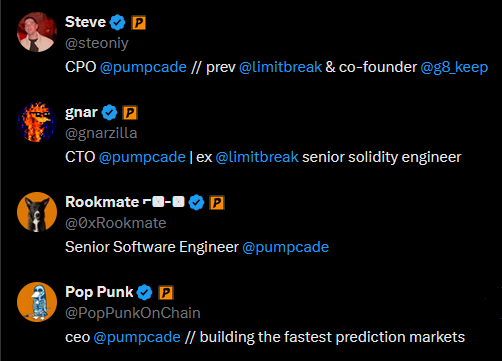
<p>The founder and CEO is Harrison Leggio. He is well known into the EVM and gas optimization space, proving his ability to build and his involvement in web3 and quit his dream job to build Pumpcade (that he initially launched as a side project). From what I see on X they are now a team of 4 people, probably all engineers. Some already founded projects (g8_keep) and a lot of them previously worked at limitbreak.</p>

<figure class="team-photo">
<img src="../assets/pumpcade_team.PNG" alt="Pumpcade team on X" />
</figure>

<div class="team-signals">
  <div class="team-signals-column team-signals-column--positive">
    <p class="team-signals-title">Synthesis of positive signals</p>
    <ul>
      <li>Community give back 10% of the supply in order to apply to the Pump.fun hackathon (confidence from community)</li>
      <li>skilled web3 team</li>
      <li>good and very active communication</li>
      <li>clear roadmap with healthy vision</li>
      <li>fast pace</li>
    </ul>
  </div>
  <div class="team-signals-column team-signals-column--negative">
    <p class="team-signals-title">Synthesis of negative signals</p>
    <ul>
      <li>All team members aren't fully public</li>
      <li>Every member role and expertise would be a positive signal</li>
    </ul>
  </div>
</div>

<h2 id="token">Token</h2>

<div class="synthesis-specs">
<ul>
  <li><span>Supply : </span>1B tokens</li>
  <li><span>Chain : </span>Solana</li>
  <li class="synthesis-spec-wide"><span>Contract :</span> <code>Eg2ymQ2aQqjMcibnmTt8erC6Tvk9PVpJZCxvVPJz2agu</code></li>
</ul>
</div>

<p>The token is the product of a fair launch on Pumpfun. This creates a healthy token price as there is no inflation and not that much tokens that VCs can dump. The launch was so healthy that the community had to give back 10% of the supply to the dev in order for him to apply to the Pump.fun hackathon. Those tokens had then been in the deals of the VC raises that occurred. In order to align the team’s interests, they did an ACE round to exchange equity for tokens. The round closed with 5% of the total supply. Even if the token price is purely speculative right now, it’s on the team’s roadmap to create <a href="https://x.com/pumpcade/status/2049851305074590178">value capture mechanisms</a> and to give it a role, without requiring users to use a solana wallet and buy the token.</p>

<h2 id="valuation">Valuation</h2>

<p><em>As I’m writing this article, the price pumped more than 40%, pricing the beta launch of tomorrow.</em></p>

<div class="synthesis-specs">
<ul>
  <li><span>Price snapshot : </span>0,02546$</li>
  <li><span>Mcap : </span>25,519,950$</li>
  <li><span>FDV : </span>25,519,950$</li>
</ul>
</div>

<p>In order to try to evaluate the token price, I will base my reflexion on the company last valuation during the ACE round of 2.5B $PUMPCADE.
Also, to evaluate the potential revenue, I will assume that the company only captures a fraction of the donation money from Twitch, that users could use in this new feature. This totally neglects the revenue that could come from Youtube, Kick or Pump.fun platforms and growth of the money used in livestreams.</p>

<p>Twitch monthly donation volume : 13M$ (fees included)</p>

<div class="metrics-table-wrap metrics-table-wrap--plain">
<table class="metrics-table">
  <thead>
    <tr>
      <th></th>
      <th>Bear</th>
      <th>Base</th>
      <th>Bull</th>
    </tr>
  </thead>
  <tbody>
    <tr>
      <th scope="row">Key assumption</th>
      <td>2% Twitch donations capture; slower platform adoption and regulatory challenges</td>
      <td>5% Twitch donations capture; conservative GTM execution</td>
      <td>20% Twitch donations capture; fast adoption</td>
    </tr>
    <tr>
      <th scope="row">Est. monthly revenue</th>
      <td>260k$</td>
      <td>650k$</td>
      <td>2.6M$</td>
    </tr>
    <tr>
      <th scope="row">Revenue multiple</th>
      <td>3x</td>
      <td>5x</td>
      <td>7x</td>
    </tr>
    <tr>
      <th scope="row">Company valuation</th>
      <td>9.3M$</td>
      <td>39M$</td>
      <td>218.4M$</td>
    </tr>
    <tr>
      <th scope="row">Implied $PUMPCADE</th>
      <td>~0.004$</td>
      <td>0.016$</td>
      <td>~0.087$</td>
    </tr>
  </tbody>
</table>
</div>

<p>As I’ve been very conservative on a number of hypotheses, I will start to slowly create a bag from 0.0175$ (base scenario).</p>

<p><em>Hypotheses will evolve with the project advancements</em></p>

<h2 id="conclusion">Conclusion</h2>

<p>I want to expose myself to this project as a VC play. The team seems healthy and to have the ability to build. They well placed on a clear segment in a hot and growing market. They also want to build a product for non crypto users, but thanks to a community. What if this was the sweetspot structure ?
Being pre-product right now, places the investment as a pure bet on the team and I could revise the preceding valuations when evolutions will occur. I’m riding along with them.</p>

<p><em>Carlos</em></p>

<p><em>This is my own thoughts. Not financial advice.</em></p>]]></content><author><name></name></author><category term="VC" /><category term="Web3" /><category term="prediction-markets" /><summary type="html"><![CDATA[I’m long $PUMPCADE. Team is aligned with token holders, communicates transparently and is building a product genuinely new in a market that’s just getting started. Here is my detailed analysis.]]></summary></entry><entry><title type="html">DePIN: Why I’m bullish</title><link href="/depin-thesis/" rel="alternate" type="text/html" title="DePIN: Why I’m bullish" /><published>2026-04-30T18:31:34+00:00</published><updated>2026-04-30T18:31:34+00:00</updated><id>/depin-thesis</id><content type="html" xml:base="/depin-thesis/"><![CDATA[<p>DePIN (Decentralized Physical Infrastructure Network)is a new way of creating, managing and owning any infrastructure our societies use.</p>

<p>The DePIN market is one of the rare real crypto use cases, providing real value to end-users (via services) and service providers (through token incentives). DePIN projects can provide two type of services :
<strong>1. Physical</strong>: mobile network, road-mapping, weather stations, energy grids etc.
<strong>2. Digital</strong> : file storage, AI model training on GPU, internet bandwidth</p>

<p><strong>But why do we need to decentralize the physical infrastructures of our world ? What does blockchain bring to our already existing physical infrastructure ?</strong></p>

<p>I think the main reasons why we need DePIN are the following :</p>
<ul>
  <li>Today’s physical infrastructures are controlled by a few big players. The structure of such sectors prevent any new entrant (big investments required, lobbies in place etc.). The issue with such market structure is it slows down innovations and prevents price collapse.</li>
  <li>It provides a new way for people to monetize their hardware by adding it in the network and letting other people use it (directly or through produced data). Customers benefit from a service at lower cost and better quality. Resources exist, demand exists, DePIN links them.</li>
  <li>Speaking of quality, DePIN can indeed improve existing services as a decentralized network follows human density and so provides a better granularity and data quality. Transparency allows anyone to check the quality of the service provided, preventing abusive behavior. New applications will emerge as DePIN allows applications and businesses-models which were non-viable before to exist.</li>
</ul>

<p><strong>Market data</strong></p>

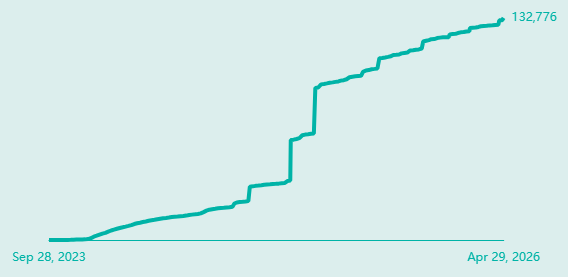
<p>Usage metrics of some projects have increased regardless of the price-action of the token.</p>

<p><img src="../assets/depin_evo_heliummobile_devices.PNG" alt="Number of Helium Mobile hotspot devices over time" /></p>

<p class="legend"><em>Legend: Helium Mobile hotspot growth (Sep 2023–Apr 2026).</em></p>

<p>Let’s be honest : if you look only at the token prices you could think that projects are dead. There has been some euphoria, there has been some FUD, there has been some mistakes. But the underlying business stayed and current prices could be a really great investment opportunity.
TAM is estimated at about 3500 Md$  by 2030. Even though DePIN captures only a small market share  it leaves a lot of room for growth as it sits today at 6.5 Md$ MCap. 
<em>ex: capture 10% of TAM → 350 Md$ MCap → a <strong>x50</strong></em></p>

<p><strong>Risks</strong></p>

<p>Of course there are still some risks with the market as there are still some gray zones:</p>
<ul>
  <li>Regulatory speaking there is still a lot of uncertainty about the tokens categorization, even if recent decisions gave us hope.</li>
  <li>Projects have to make sure that tokenomics allows an organic growth of the network while reducing the probability of a death spiral.</li>
  <li>DePIN has to prove service consumers and users the value of their network compared to already-existing web2 competitors, in order to make them participate in the PIN.</li>
</ul>

<hr />

<p>As a retail investor, I will invest in DePIN projects as I’m convinced that it will bring a lot of value to the world. Market actual problems will be insignificant in a few years, as innovations and new plays will enter. Some of the next decade infrastructures will partially rely on DePIN.
I think we will see more and more projects starting to launch their flywheel, creating a more prosperous ecosystem where the growth is less and less due to token subsidies. To do so, we have to onboard non-crypto native users and to take care of their UX. It is also a real opportunity for them as they can improve their services thanks to us. This statement is true for web3 overall.</p>

<p>Regarding my investments I’ll focus on projects with real use cases and business models bringing value thanks to blockchain. I’m only focusing on post-TGE as I don’t have any specific deal flow.
Metrics I follow are : the number and growth rate of users;  revenue; tokenomics.</p>

<p>I will keep you updated about any investment and entry or exit prices as I manage them.</p>

<hr />

<h4 id="main-sources">Main sources</h4>
<ul>
  <li>Messari, <em>State of DePIN 2024</em> (déc. 2024) et <em>State of DePIN 2025</em> (jan. 2026)</li>
  <li>Grayscale Research, <em>The Real World: How DePIN Bridges Crypto Back to Physical Systems</em> (fév. 2025)</li>
  <li>The Block Research, <em>The DePIN Report 2025</em></li>
  <li><em>CoinGecko</em> (catégorie DePIN) et <em>DePINscan</em> — données de marché</li>
  <li><em>Gartner</em>, <em>Statista</em>, <em>Fortune Business Insights</em> — estimations TAM</li>
  <li>Boosty Labs, <em>DePIN: The $3.5 Trillion Infrastructure Revolution</em> (août 2025)</li>
  <li>Bistroo, <em>Exploring the Total Addressable Market for the DePIN Sector</em> (2024)</li>
</ul>

<p><em>Carlos</em></p>]]></content><author><name></name></author><category term="VC" /><category term="Web3" /><category term="DePIN" /><category term="infrastructure" /><summary type="html"><![CDATA[DePIN (Decentralized Physical Infrastructure Network)is a new way of creating, managing and owning any infrastructure our societies use.]]></summary></entry><entry><title type="html">Investments philosophy</title><link href="/my-vision/" rel="alternate" type="text/html" title="Investments philosophy" /><published>2026-01-03T15:43:54+00:00</published><updated>2026-01-03T15:43:54+00:00</updated><id>/my%20vision</id><content type="html" xml:base="/my-vision/"><![CDATA[<p>I’m at a point in my life where I can look for low probability high return investments, as I have nearly no responsabilities. I do so by investing early in projects (VC) or by exposing my portfolio to high potential markets. The one I’m the more exposed to (to not say only) is web3. I have a very low diversification in other markets. Without successes, this time will not last forever as I’ll need to dilute my risk when I’ll have a family for example, but I need to play this game now if I want to take the opportunity to change my (and my family) financial path.</p>

<p>I’m more enclin in web 3 and VC as they both are highly volatile markets and so potentially provide high returns. But my love for those domains goes beyond pure financial returns.</p>

<p>Doing early investments is of course a way to maximize potential outputs. But it is also a way to deep dive into a market in order to better understand it, build relationships, a network etc. Indeed, the access to deals and selecting the good ones being difficult, you have no other way around than to better understand what you’re investing in, have insights from other people etc. It differs a lot from low risk assets : S&amp;P 500, ETF’s, … where a lot of people do not really understand what or why they’re buying (and to be honest, you don’t need it as you’re not really actively managing a portfolio).</p>

<p>As a VC, my goal is to capture as much growth as possible from this market and doing so by joining entrepreneurs and giving them some fuel. They need fuel to build what they have in mind and what they all have in common is to make the market a better place and get rewarded for it.</p>

<p>VCs, we always win. At least long term. Even if we don’t financially win.
Let me explain my thoughts: If you look at the market in macro, even the startups that failed made the market have a positive impact:</p>
<ol>
  <li>They made the kind of solution known and understand by potential customers, embedding new users</li>
  <li>I a way, they may have improve the technology or even unlock a bottleneck.</li>
  <li>They made research in the field</li>
  <li>They tested an innovative approach to a problem</li>
  <li>Employees improved their skills</li>
  <li>It inspire people (customers, employees, or just spectators) to do things in this market</li>
</ol>

<p>No startup does nothing at all. All this work, as tiny as it can be, will compound over time and will nourrish the market.</p>

<p>Most projects fails. Some succeed. That’s the hard rule of the world. But we have to back entrepreneurs who wants to make the wheel start and try to build something. And one day, all the stars will be aligned for an entrepreneur to succeed. Everything would have been setup and nurtured by all the previous failures and by hard work and dedication he will succeed. As an investor, you surely want to be here at this time. But the probability of being present in the market just at this time is very low. You greatly improve the probability if you were there early on, pushed the market, the entrepreneurs, suffer setbacks : TL;DR &gt; nurture the market. All efforts pays one day.</p>

<hr />

<h4 id="notes">Notes</h4>
<p>I view web3 as a specific type of VC investment. You can position yourself by buying the token or while investing in the compagny. Market being liquid and volatile, you can even have early deals a few years after token launch.</p>

<p><em>Carlos</em></p>]]></content><author><name></name></author><category term="VC" /><category term="Web3" /><category term="AI" /><summary type="html"><![CDATA[I’m at a point in my life where I can look for low probability high return investments, as I have nearly no responsabilities. I do so by investing early in projects (VC) or by exposing my portfolio to high potential markets. The one I’m the more exposed to (to not say only) is web3. I have a very low diversification in other markets. Without successes, this time will not last forever as I’ll need to dilute my risk when I’ll have a family for example, but I need to play this game now if I want to take the opportunity to change my (and my family) financial path.]]></summary></entry></feed>